Biography
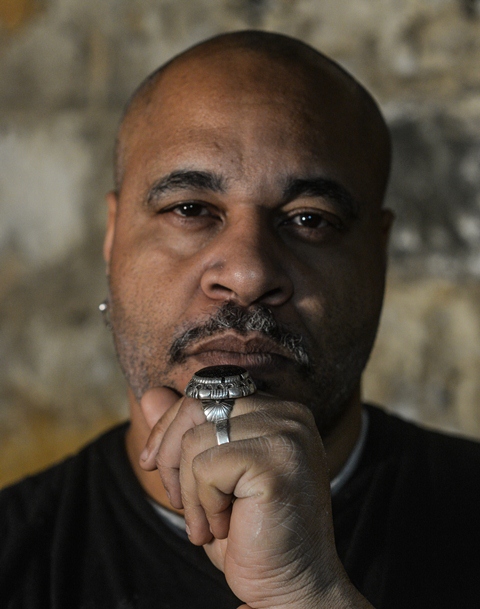
Johnson’s passage into this practice was sharpened through his apprenticeship with Nicholas Mukomberanwa (1940–2002), the Zimbabwean sculptor and national hero, from 1996 to 1999. Under Mukomberanwa, Johnson absorbed a language of touch where stone was less medium than interlocutor, less surface than archive. This training was not a mere technical formation but a ceremonial induction into the Shona continuum of carving, extended into the improvisational urgency of Black America. Out of this nexus comes a body of work in which stone itself seems to breathe, to hesitate, to move fugitive.
Born and raised in Inkster, Michigan, Johnson came of age in the sonic laboratory of Detroit techno—a site where Black futurity learned to inhabit circuitry, loop, and pulse. That machinic rhythm permeates his sculptural vocabulary, as syncopation and repetition are transposed into line, cut, and void. His sculptures embody what might be called an Afrosurrealist materialism: objects that emerge from atavistic memory but feel like fragments of a dream projected into matter. Like Afrosurrealist writing and film, Johnson’s carving bends reality into myth, staging a refusal of the ordinary. His stone forms are simultaneously ritual artifacts and speculative instruments, collapsing the distance between ancestral invocation and futuristic speculation.
Johnson’s work has entered and disturbed the spaces of permanence: the collections of Hampton University Museum (VA), Kenkeleba House (NY), the Schomburg Center for Research in Black Culture (NY), and the U.S. Embassy in Oslo, Norway. His exhibitions map the diaspora’s fugitive routes: Columbia University (NY); the Embassy of the Republic of Ghana (D.C.); Galerie Myrtis (MD); Harvard University; Hampton University Museum (VA); Kenkeleba House (NY); Fabric Projects Gallery (Los Angeles); United Talent Agency ArtSpace (Los Angeles); Wilber Jennings Gallery (NY); TransAfrica Forum; the National Gallery of Zimbabwe; Grey Gallery at New York University; the Museum of Contemporary Diasporan Art (Brooklyn, NY); Rush Arts Gallery (NY); the Schomburg Center for Research in Black Culture (NY); the New York Botanical Gardens; Tafaria Castle & Center for the Arts (Nyeri, Kenya); the Charles H. Wright Museum of African American History (MI); JELMA Museum at Morgan State University; the Reginald F. Lewis Museum of Maryland African American History; the 13th Havana Biennale at Galeria Carmen Montilla, Cuba; and the 59th Venice Biennale Personal Structures: Time, Space and Existence at Palazzo Bembo. Each exhibition is less a placement than an unfolding: his objects act as portals, uncanny in their stillness, charged with a rhythm you almost hear.
Since 2002, Johnson has been an artist-in-residence at the Schomburg Center for Research in Black Culture, where pedagogy becomes sculpture, and youth become collaborators in an intergenerational installation. His public exhibitions with Black youth have appeared across New York City: at the Williamsburg Historical Society, Bronx Historical Society, Cork Gallery in Lincoln Center, and The Town Hall. This work extends the Afrosurrealist ethos into education itself, producing not only objects but collectives, not only forms but futures.
In Johnson’s hands, stone refuses silence, articulating memory through form, carrying ancestral weight while pressing forward into new futures of Black expression.